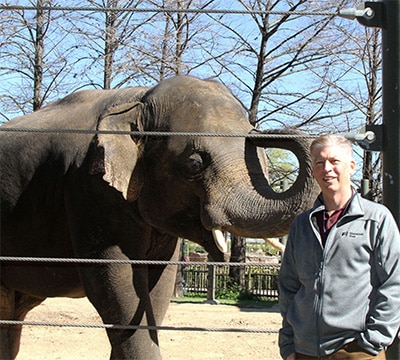
About Elephants
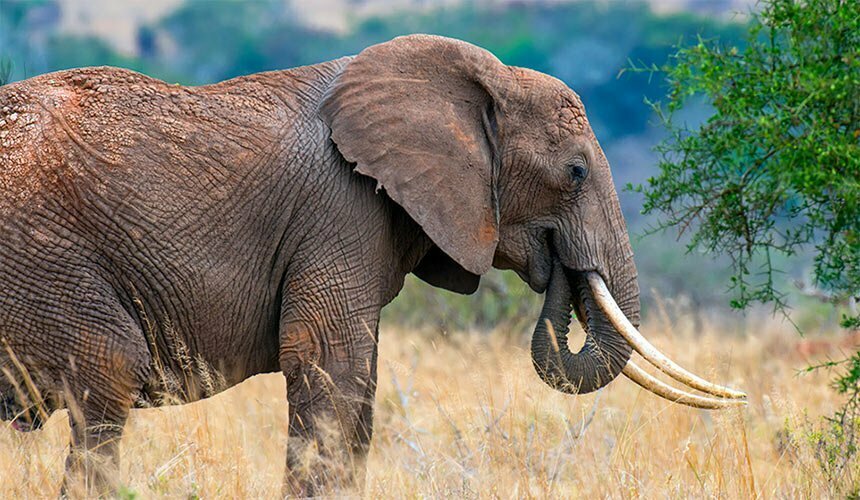
African savannah elephant
Loxodonta africana
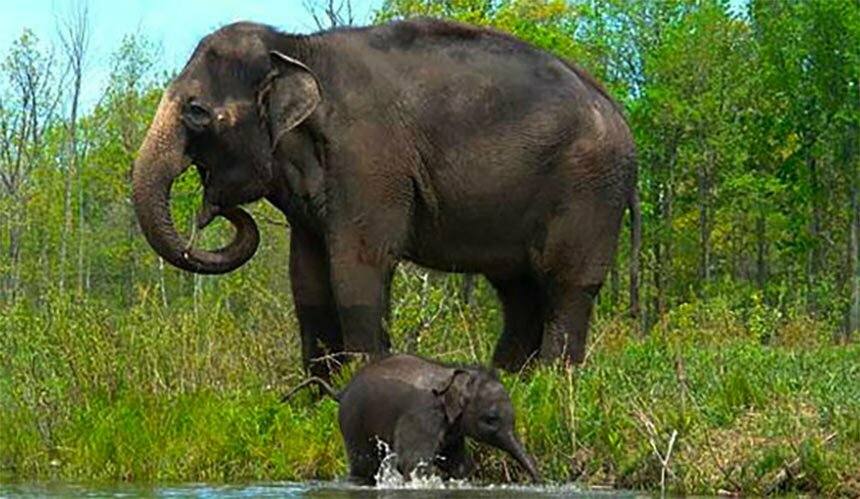
Asian elephant
Elephas maximus

African forest elephant
Loxodonta cyclotis
Meet the Elephants
Three elephant species walk the earth today: the African savannah elephant (Loxodonta africana), the African forest elephant (Loxodonta cyclotis), and the Asian elephant (Elephas maximus). All three are in trouble. Habitat loss, human development, and poaching continue to drive their populations down, and as humans push deeper into elephant range, human–elephant conflict is intensifying. When elephants venture into former habitat now planted with crops, both people and elephants can be injured or killed.
Despite their differences, elephants share a recognizable blueprint. Males are larger than females, and both sexes keep growing throughout their lives. Their feet are wide and round, and their weight rests on a fibrous pad under the toes that grows continuously and wears down with use. Their skin is wrinkled and sparsely haired. And of course, every elephant has the most versatile nose in the animal kingdom: the trunk, a fusion of nose and upper lip used to breathe, smell, communicate, drink, bathe, push, carry, and pick up objects as small as a peanut. The trunk is so essential that injured elephants, including those that lose a portion of their trunk to poachers’ wire snares, must learn entirely new ways to use it to survive.
Female elephants are deeply social, spending their lives raising calves alongside relatives. Males leave their family group as teenagers and form loose, shifting bonds with other bulls, except during “musth,” when they travel alone. Most of what we know about elephant society comes from the African savannah elephant; forest and Asian elephants are harder to study in their dense habitats, but the broad pattern appears similar.
African savannah elephant (Loxodonta africana)

African savannah elephants are the largest land animals on Earth. Adults typically range from 8 to 14 feet at the shoulder and roughly weigh 8,000 to15,000 pounds. Their unmistakable ears—shaped roughly like the African continent—help them communicate and shed heat. Both sexes typically grow tusks (continuously growing upper incisors), and the tip of the trunk has two finger-like projections capable of remarkable precision, working like a person’s thumb and index finger that can pick up an object as small as a dime.
Primarily grazers, savannah elephants roam the grasslands and bush of subSaharan Africa. Family unites usually includes five to eight related females and their offspring. As these groups grow through the birth of new family members, they eventually split into smaller family units. During times of abundant water and vegetation, these related families reunite, forming larger associations known as clans that come together and disperse with the seasons and shifting resources. Females give birth roughly every three to five years after a 22-month pregnancy.
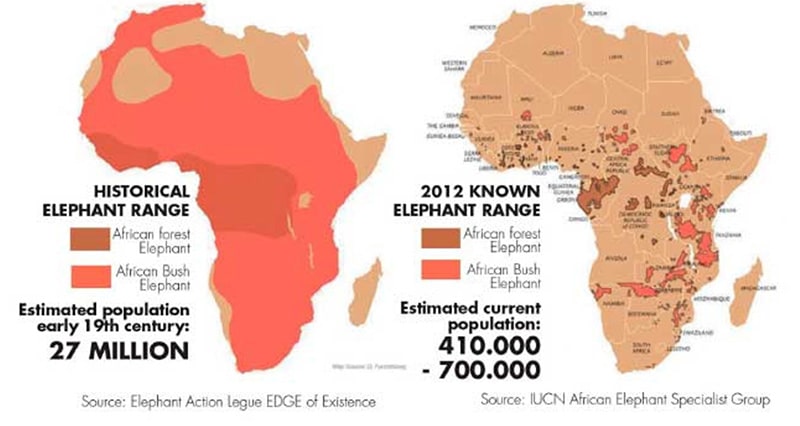
Once spread across the continent, elephants disappeared from northern Africa by the Middle Ages, largely because of the ivory trade. Numbers rebounded after WWI thanks to controlled hunting and protected areas, but a 1970s spike in ivory prices reignited poaching, and the population fell from an estimated 1.3 million to under half that by 1995. Today, around 350,000 to 375,000 savannah elephants remain. They’re listed as endangered, though some southern and eastern African populations are stable or growing.
African forest elephant (Loxodonta cyclotis)
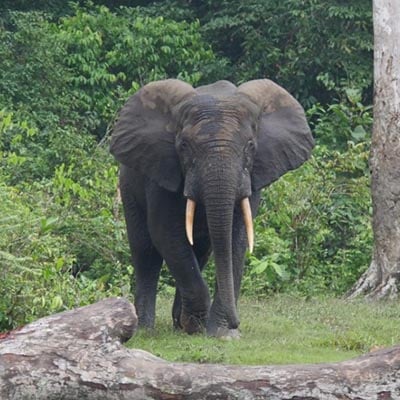
Long thought to be a subspecies of the savannah elephant, recent genetic work confirmed the forest elephant as a separate species. It’s the smallest of the three at generally 6 to 10 feet tall and up to 10,000 pounds, with smaller, rounder ears and tusks that are slimmer, straighter, and angled toward the ground. Like its savannah cousin, its trunk tip has two finger-like projections.
Forest elephants are primarily browsers and fruit-eaters, central to the ecology of the dense forests of western and central Africa. Their family groups appear smaller and looser than savannah herds, though the social pattern is similar. Gestation and reproductive interval mirror the other species.
Estimating their numbers is genuinely difficult because dense canopy and political instability make census work nearly impossible, but the best current estimate is over 100,000, with about 95,000 in Gabon alone. The species is critically endangered. Logging, agriculture, and road-building fragment their habitat and open the forest to poachers.
Asian elephant (Elephas maximus)
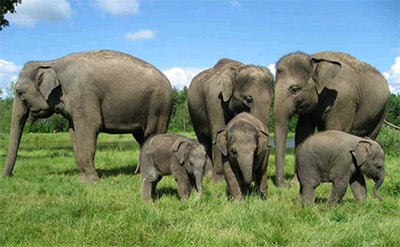
The second-largest land mammal, Asian elephants have four recognized subspecies: Indian (E. m. indicus), Sri Lankan (E. m. maximus), Sumatran (E. m. sumatranus), and Malayan (E. m. hirsutus). Adults roughly stand7 to 13 feet tall and weigh 6,000 to 14,000 pounds.
Compared to African elephants, the Asian elephant looks subtly different: smaller, rectangular ears; lightly wrinkled skin; and a single finger-like projection on the trunk tip that is still dexterous enough for delicate work. The tusks tell a different story too: they’re usually only prominent in males, while females have small “tushes” that rarely extend past the lip. Tuskless males also occur in some regions.
Asian elephants have four recognized subspecies: Indian (E. m. indicus), Sri Lankan (E. m. Often, Asian elephants are forest dwellers, traveling in family groups that, like forest elephants, are smaller and less cohesive than savannah herds but join into larger gatherings when food and water allow. Females give birth every three to five years after a 22-month gestation.
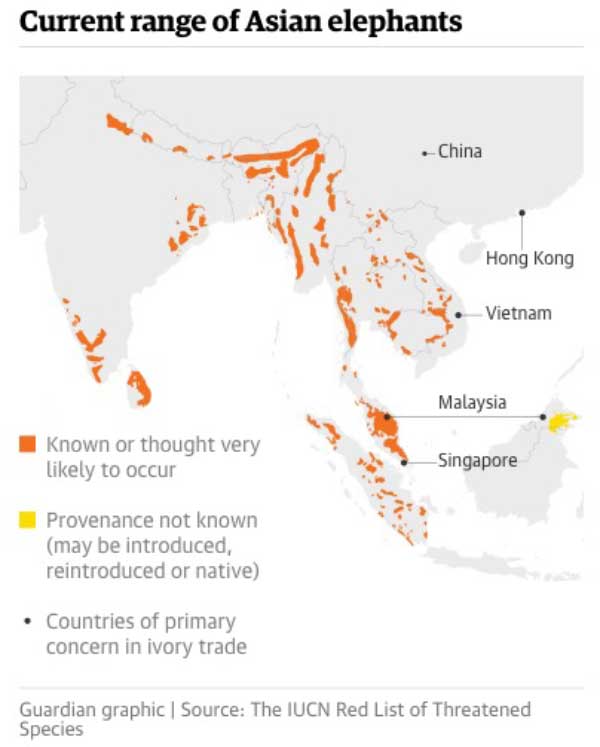
The Asian elephant once ranged from the Tigris-Euphrates across Iran, India, and Southeast Asia, into Indonesia, and north into China as far as the Yangtze. They’ve vanished from western Asia, Iran, and most of China, and survive today in just 13 countries.
The story of Asian elephant conservation today fundamentally is one of habitat loss. About 20% of the world’s people live in or near Asian elephant range. India’s forests now cover less than 20% of the country, and only about half of that is suitable elephant habitat. Thailand has cleared nearly all its lowland forest. Many of Sumatra’s forests were converted for resettlement and the remaining are now being cut down for palm oil; Vietnam has lost more forest since the war than during it. Sri Lanka’s Mahaweli River project cuts through the heart of elephant country. The result is fragmentation: only an estimated 10 populations of more than 1,000 animals remain across the species’ entire range. The total wild population is between 30,000 and 50,000, about a tenth of Africa’s elephants combined. The species is endangered.
Ears and Staying Cool
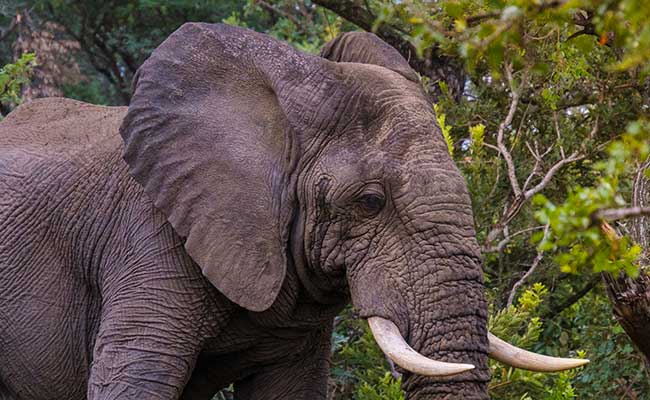
African elephant ears
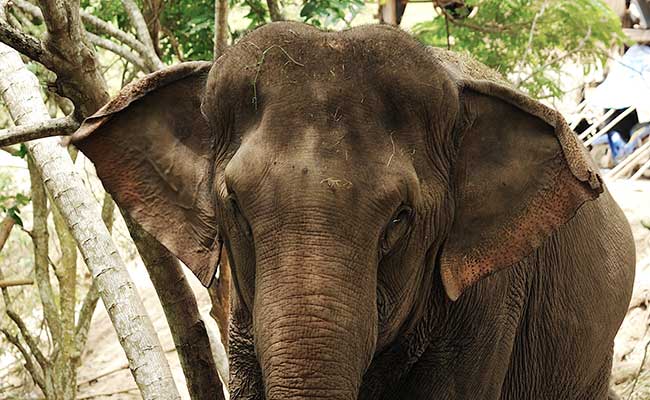
Asian elephant ears
An African elephant’s ear can stand six feet tall, span five feet across, and weigh about 100 pounds. Asian elephants have noticeably smaller, more rectangular ears, a difference that tracks with climate and habitat. The hotter and sunnier the habitat, the bigger the ear, because ears are part of how elephants manage their body temperature.
Ear-flapping cools an elephant in two ways: it moves air across the body like a fan, and it cools the blood circulating through the dense network of veins inside the ear before sending it back into the body. On a windy day, an elephant may simply face into the breeze and hold its ears out to do the same job for free. Splashing water on the ears makes the cooling even more efficient.
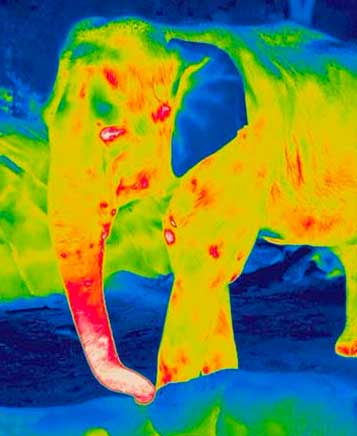
But the ears aren’t the whole story. Researchers using thermal cameras discovered that elephants also have up to 15 “hot spots” scattered across their bodies, small patches of skin where they can dilate blood vessels on demand to dump heat. These thermal windows expand as the air warms up, and combined with ear-flapping and bathing, they let elephants hold a steady core temperature of about 36°C (one degree below ours). It’s a remarkably fine-tuned system for an animal once dismissed as having thick, insensitive skin.
Cold weather simply flips the equation. Elephants close down those skin patches, hold their ears still and flat against the head to minimize heat loss, and rely on their sheer bulk to retain warmth. Asian elephants, whose range extends into cooler forests and the foothills of the Himalayas, have noticeably more body hair than their
African relatives, particularly as calves. Both species can tolerate surprisingly chilly temperatures when they need to, but given the choice they’ll seek out a sunny spot, huddle close to other members of their group, or take shelter from wind and rain.
Ears do double duty in communication, too. They’re tuned to catch faint sounds across long distances, and a threatened or angry elephant will spread them wide, adding up to ten feet of apparent width to an already enormous animal.
Skin
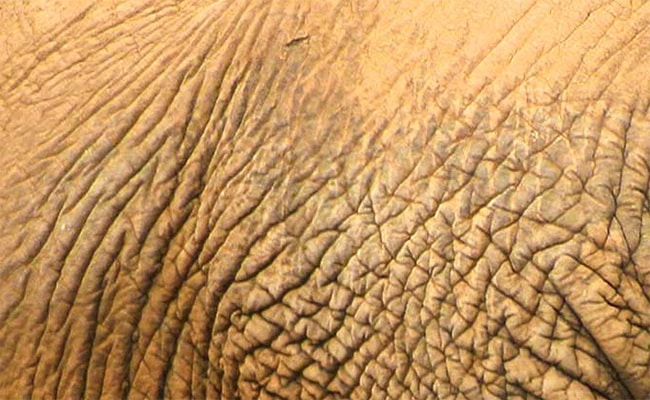
African elephant skin
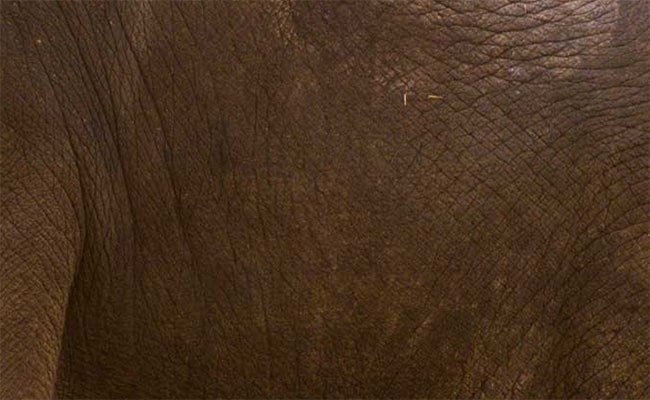
Asian elephant skin
Elephant skin can weigh as much as 2,000 pounds. It’s an inch thick across the back and as thin as a tenth of an inch on the ears and around the mouth. Despite looking rough and dry, elephant skin can be surprisingly soft to the touch. Wrinkles aren’t just for show: they trap moisture and keep skin healthy in dry climates, and they increase surface area to aid in body temperature regulation. African elephants have more pronounced wrinkling than Asian elephants.
The natural color of elephant skin is grayish-black, but elephants tend to look like the dirt they live on, because they constantly throw it on themselves. Mud and dust baths protect against insects and sunburn, regulate temperature, and condition the skin. Some Asian elephants also show pink or light-brown depigmented patches, a trait shaped by genetics, age, nutrition, and habitat. African elephants don’t show this.
Despite their size and heat, elephants have very few sweat glands, all clustered around the toenails. On a hot day, you may notice damp skin around the top of an elephant’s foot. The only other visible glands are the mammary glands and the temporal glands, which are found on each side of the head between the eye and ear. In females, temporal glands may activate during exciting periods; in males, they signal musth.
The natural color is grayish black, but an elephant usually appears to be the same color as the soil where the elephant lives. This is because elephant’s take frequent mudbaths or dust with soil to protect against insects, to control body temperature, to condition and moisturize the skin, and to protect against sunburn.
One way a person regulates body temperature is by sweating – on a person, sweat glands are located throughout their skin. Elephants have very few sweat glands. The few sweat glands that an elephant has are located on the foot, near the cuticles. This results in a skin that is dry to the touch but soft and supple. If you look at an elephant on a hot day, you may see a wet area around the top of their toenails.
The only visible glands that are found on the skin of an elephant are the mammary glands and the temporal glands. Elephants have one temporal gland on each side of the head between the eye and the ear. The temporal gland is a large gland, much like a sweat gland, that sometimes produces a secretion that trickles down the side of the face. In female elephants, these glands may become active when the animal gets very excited. In male elephants, the temporal glands are active when the male is in “musth”, which is a condition very much like “rut” in a deer.
Teeth
Elephants chew with four massive, ridged molars built for grinding tough vegetation. Molars are positioned in the mouth so that an elephant has one molar per side, per jaw A single adult molar can be 10 to 12 inches long and weigh more than eight pounds. Look closely and you can tell the species apart: an Asian elephant’s molar has parallel ridges, while an African elephant’s forms a diamond pattern. That diamond shape is actually where the genus name Loxodonta (Latin for “slanted teeth”) comes from.
What makes elephant teeth remarkable is how they’re replaced. Instead of growing in fixed sockets, molars move forward through the jaw on a kind of conveyor belt, with new teeth emerging at the back and old, worn ones falling out at the front.
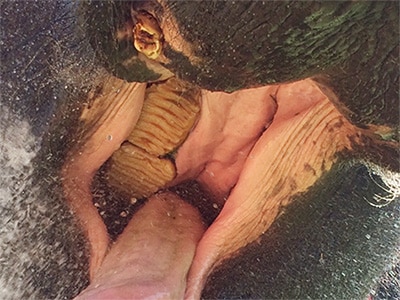
Asian elephant tooth
An elephant uses only four molars at a time but cycles through six sets in a lifetime. The final set typically erupts in their early forties, and once those wear smooth, the elephant can no longer chew effectively. Tooth wear, more than anything else, sets the natural lifespan of an elephant. (Manatees and kangaroos are the only other mammals known to replace teeth this way.)
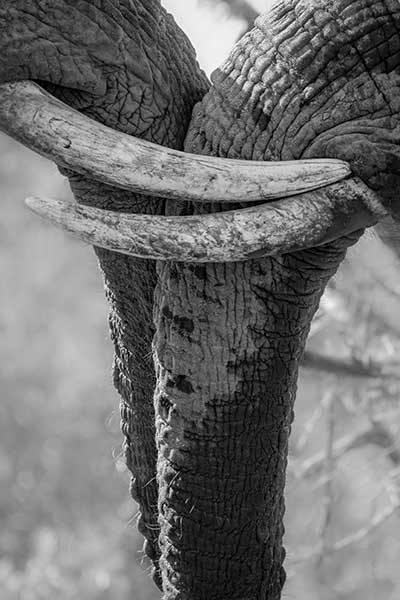
Tusks are the other dental headline. Like the molars, they’re modified incisors (upper ones, in this case), and they grow throughout an elephant’s life, with roughly a third of their length anchored inside the skull. Tuskless individuals occur in all three species. Generally, both males and females in African savannah and forest elephants have tusks. Only some male Asian elephants have tusks, and female Asian elephants lack prominent tusks, but may have smaller tusk-like structures called “tushes.”
Tusks are made of dentine, the same dense material that forms the core of human teeth. That dentine is what the world calls ivory, and demand for it has shaped elephant history more quickly than any other single force. Ivory hunting drove elephants to extinction across northern Africa by the Middle Ages, halved Africa’s elephant population between 1970 and 1995, and continues to fuel poaching today.
The pressure is even reshaping elephant biology: in some heavily poached populations, the proportion of tuskless females has risen sharply because elephants without tusks are more likely to survive long enough to pass their genes on.
Musth
Musth (rhymes with “bust”) is a heightened reproductive state in male elephants, driven by a surge in androgens like testosterone. It announces breeding intent to females, helps resolve competition between bulls, and synchronizes reproduction across wild populations. Males in musth can be aggressive, unpredictable, and dangerous to other elephants and to people.
For the human communities that share elephant range, musth bulls are disproportionately involved in human-elephant conflict. For the people who care for elephants in zoos and range-country camps, musth requires experienced handlers and specialized protocols. And for conservationists working to sustain populations under human care, understanding musth as a natural reproductive strategy rather than just a management headache is increasingly important to successful breeding.
Communication
Elephants communicate using a rich blend of deep rumbles, vocal calls, and physical signals that help them stay connected across long distances and within tight‑knit social groups.
Elephant Vocals
Elephant Grumbles & Growls
Elephant Trumpets
Elephant communication is remarkably complex, relying heavily on infrasound—low‑frequency rumbles so deep they travel miles across the savanna and through the ground, allowing elephants to coordinate movement, greet one another, and warn of danger even when they’re far apart. These powerful rumbles often fall below the range of human hearing, yet other elephants detect them through both their ears and the sensitive pads of their feet, which pick up subtle ground vibrations.
Beyond rumbles, elephants communicate through touch, posture, trunk gestures, and even scent creating a layered language that supports everything from bonding and caregiving to conflict avoidance and mating. Their ability to send and receive long‑distance messages plays a vital role in survival—helping them find water, stay in contact with family, and navigate vast landscapes. This intricate communication system reflects the intelligence and social complexity that make elephants one of the most extraordinary species on Earth.
Elephant Conservation
Elephants face an interconnected web of threats. Poaching, deforestation, conflict with people, vulnerability to disease, and the slow erosion of local conservation capacity each pose serious dangers on their own, and they reinforce one another in ways that compound the harm. A forest cleared for farmland fragments a population’s range, sharpens conflict with nearby villagers, opens new paths for poachers, and shrinks the herd size that once helped young calves build natural immunity to disease. No single fix solves all of it. But the most effective conservation work tackles these threats together, with the people who share land, water, and risk with elephants leading the way. Below are the five threats IEF works hardest to address and the projects you can support to help transform the future for elephants.
Poaching

For all the threats elephants face, none has shaped their history more violently than the ivory trade. Demand for tusks drove elephants out of northern Africa by the Middle Ages, and a 1970s spike in ivory prices triggered a poaching wave that cut Africa’s elephant population from an estimated 1.3 million to under 500,000 in just two decades. The 1989 international ban on commercial ivory trade slowed the killing but never stopped it. Illegal markets continue to drive poaching today, with forest elephants hit especially hard because logging roads have opened their once impenetrable habitat to traffickers. Asian elephants face poaching pressure too, though there it tends to target tusked males for ivory, with skin, meat, and live calves emerging as secondary targets.
Stopping poaching requires action at every link of the chain: ranger patrols and intelligence networks in the field, stronger detection at borders and ports, prosecution of trafficking syndicates, and demand-reduction campaigns in consumer countries. Above all, it depends on sustained support for the people doing the most dangerous work: the rangers and community scouts who stand between elephants and poachers, often at great personal risk.

Habitat Loss & Deforestation
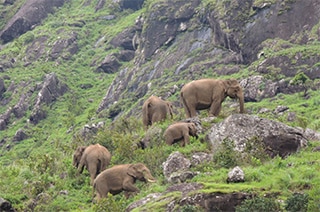
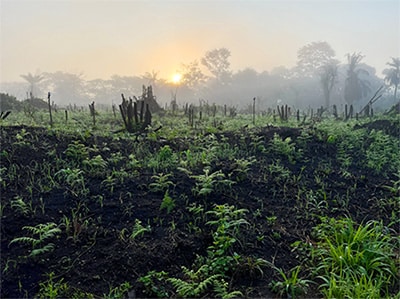
Forests are vanishing across the world, including among elephant habitat. In Asia, vast stretches of habitat have been cleared for agriculture, settlement, plantations, and infrastructure, leaving surviving elephants squeezed into shrinking, disconnected pockets. In central and west Africa, logging roads cut into once-impassable wilderness, fragmenting forest elephant range and opening it to poachers who could never have reached those populations before. Less forest means less food, less water, and fewer safe corridors between populations, which in turn fuels inbreeding, conflict, and population decline.
Deforestation is rarely just an environmental story: it’s an economic and political one too, driven by global demand for palm oil, timber, agriculture, and minerals. Lasting conservation has to work at that scale, partnering with governments, communities, and industries to protect what remains and restore what’s been lost.
Human-Elephant Conflict
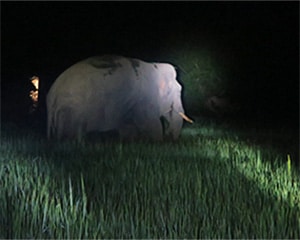
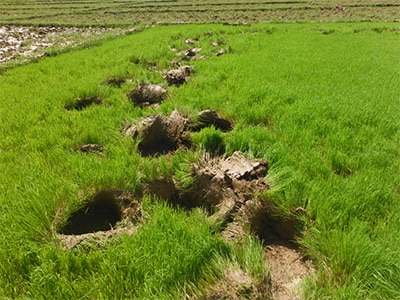
Where elephants and people compete for the same shrinking patch of land, both lose. Elephants raid crops, damage stored grain, and occasionally injure or kill people; in retaliation, farmers may shoot, poison, or trap them. A single bull elephant can flatten a season’s harvest in one night, and for a subsistence farming family, that’s not a loss, it’s a crisis. Compounding the problem, traditional migration corridors are increasingly severed by roads, railways, fences, and farmland, forcing elephants to cross human-occupied terrain to reach the seasonal food and water they’ve relied on for generations. As elephant range continues to shrink, these encounters are becoming more frequent and more dangerous on both sides.
There’s no single fix, but various tools have been met with success across elephant range countries: electrified and chili fences, early-warning networks, crop-guarding teams, compensation programs, and land-use planning that keeps elephants and people apart where possible. The most successful approaches treat farmers as partners rather than obstacles, because long-term coexistence depends on the people who actually live alongside elephants.
Community Engagement & Capacity Building
Conservation that excludes the people living alongside elephants doesn’t last. The communities sharing resources with elephants are the ones best positioned to protect them, but only if they have the training, tools, and incentives to do so. Without local buyin, even the best-funded protected areas struggle. With it, even modest projects can transform outcomes for entire species.
IEF invests in the people on the front lines: training rangers and veterinarians, equipping local conservation teams, supporting education in elephant-range schools, and strengthening in-country organizations so they can lead their own work. Strong local institutions and informed, empowered communities are what turn short-term wins into durable change.
EEHV (Elephant Endotheliotropic Herpesvirus)
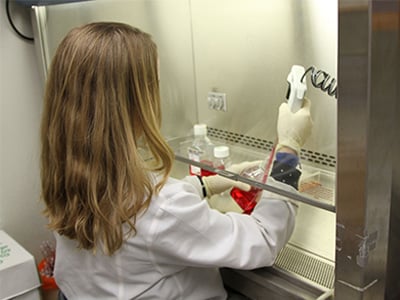
EEHV is a herpesvirus that lives quietly in nearly all elephants. Like the herpesviruses that infect humans and other animals, it usually causes no illness; adult elephants carry it for life, shedding it occasionally in trunk secretions, saliva, or feces without harm. The danger emerges in young elephants whose immune systems can’t yet hold the virus in check. When that happens, EEHV can trigger EEHV Hemorrhagic Disease (EEHV-HD): a sudden, often fatal illness in which the virus attacks the cells lining blood vessels throughout the body, causing widespread internal bleeding and circulatory collapse within days. EEHV-HD primarily strikes Asian elephant calves between two and eight years old, but it has also killed young African elephants. It is one of the deadliest diseases facing young elephants today, in human care and increasingly in the wild, particularly where habitat fragmentation has shrunk group sizes to the point where calves no longer encounter the virus while still protected by maternal antibodies.
Treating EEHV-HD requires intensive, round-the-clock care: antivirals, fluids, blood or plasma transfusions, and the kind of voluntary medical training that lets a calf calmly accept blood draws and injections from a familiar handler. Outcomes depend heavily on early detection, which is why care teams worldwide rely on routine blood monitoring to catch a rising viral load before symptoms appear. The science is advancing on multiple fronts. Improved serology tests now let veterinarians identify which calves are most vulnerable, a vaccine targeting EEHV1-A (the most lethal subtype) is moving into deployment in North America after years of research, and global collaboration through the EEHV Advisory Group continues to refine treatment protocols and expand testing into elephant range countries. Major questions remain about transmission, about why some calves develop EEHVHD while others don’t, and about the virus’s true impact on wild populations.