
Greetings,
Can you believe it is already September? Time flies, even when things aren’t going according to plan. So we are celebrating the funny, inspirational, and interesting ways some of our projects and conservationists have had to adapt in response to unforeseen circumstances in our new series, Tales From the Field. Debuting in time for Elephant Appreciation Day (THIS TUESDAY!), Tales From the Field gives you a glimpse of what it’s like working for wildlife in remote corners of the world, or even in a local airport. Check them out below!
The Scoop on Poop
by Chase LaDue
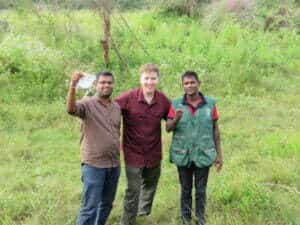 I recently had an unfortunate ordeal while traveling, one that many of us have experienced. After landing in Washington, DC, I wearily made my way to the baggage carousel, and then I waited for what seemed like an hour. You know where this is going: my checked luggage did not appear after the carousel stopped spinning. I immediately broke into a cold sweat, thinking to myself “did this really have to happen this time?” On any other trip, I wouldn’t have been so worried; I live in the Washington area, and so I simply would’ve given the airline my contact information and address so they could drop off the luggage at my home the next day. But this item was critically important: it was a cooler filled with six months’ worth of frozen elephant dung, and without it there would be a big, irreplaceable hole in my research.
My name is Chase LaDue, and I’m a biologist that studies elephant behavior and physiology, most recently through the IEF-supported project, “Musth Variation among Asian Elephants: Applications for Conservation.” I think I have the best job in the world, one that takes me all over the world to work with some of the most dedicated people and spend time in the presence of the most amazing animals. But there’s a less glamorous side: I devote an inordinate amount of my time collecting, processing, and analyzing elephant fecal samples.
Why poop? Dung can tell us so much about wildlife: what they eat, how they’re related to each other, and even what bacteria they host in their gut. I’m particularly interested in elephant dung because it teaches us about elephant physiology. Endocrinologists often rely on blood to analyze many different hormones related to a variety of processes, including reproduction, the stress response, metabolism, and overall health. However, sometimes collecting blood samples can be logistically impossible and/or stressful for the animals involved. In my case, it’s too dangerous to approach a wild bull elephant in musth to collect blood. Fortunately, various analytical tools have been developed that allow us to measure hormone metabolites (the compounds left over after hormones have been metabolized) non-invasively in dung, urine, saliva, and even hair. For my project, dung works perfectly because elephants produce plenty of it, and they don’t seem to mind me collecting some for the lab. Compared to a matrix like blood, there are more processing steps involved with extracting hormone metabolites from something like poop. Besides finding and collecting the fecal sample itself, a lot of work goes into getting data from a pile of elephant dung!
But back to the airport story. “Why were you flying with a cooler of elephant dung?” you may ask…Read the Rest of Chase’s Story
No Zoom Needed
by Lynn Von Hagen
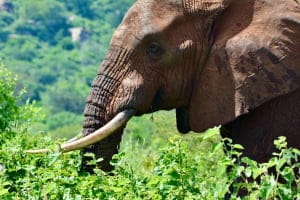 My ranger companion and I were coming back from visiting the mitigation experiments we had in a farming community in the Tsavo ecosystem of Kenya. As we often do, we encountered a group of elephants grazing; a family group accompanied by a large bull. Since we catalog all the elephants we encounter, we stopped and tuned off the engine so as not to panic the elephants. From a safe distance, we took data and many photographs. The elephants started moving towards our position. So as not to disturb them, we intended to start the car and slowly pull away. I turned the engine on. click. again. click. The engine was totally dead. We looked at each other wide-eyed and simultaneously uttered an expletive… Read the rest of Lynn’s Story